
Triangular shade sails
Three-point membranes for smaller zones, angled layouts, and layered compositions.
Shade Sails
Universal Awning plans and installs tensioned shade sails for schools, parks, playgrounds, pools, courtyards, healthcare facilities, commercial properties, and homes. The sail geometry, support points, heights, and fabric coverage are developed around the area below.
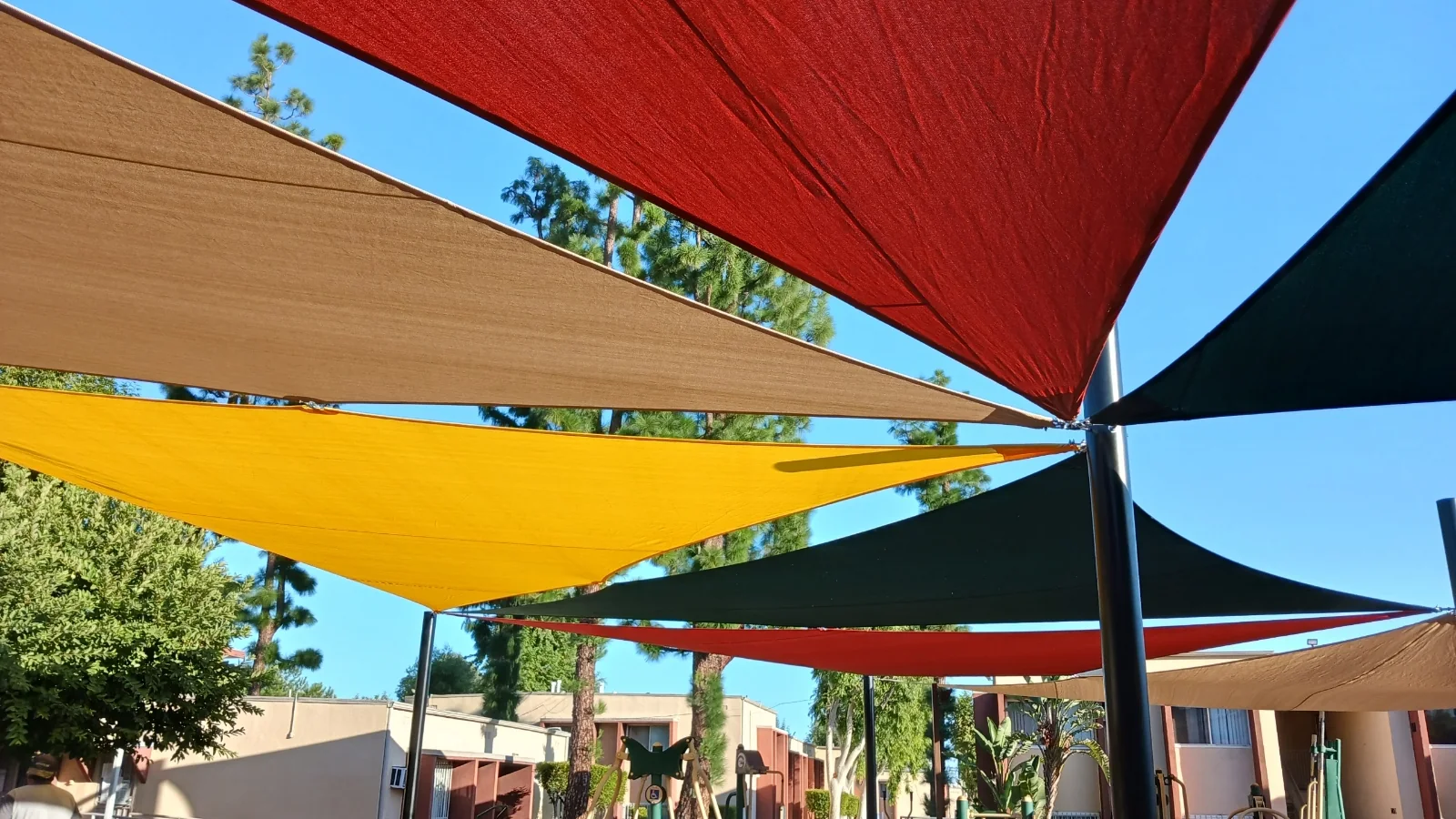
Sylmar parkOverlapping tensioned fabric shade sails
Planning the system
A shade sail is a tensioned fabric membrane stretched between posts or suitable building connections. The shape is controlled by the number and location of those anchors, so the support layout and the area to be shaded have to be planned together.
We review how the site is used, where people move, the hours when shade matters, nearby buildings and trees, available foundations, required clearances, and water runoff. Multiple sails may overlap where one large membrane would not provide the right geometry or coverage.
Available configurations
Sail count and shape are determined by the footprint, support locations, sun path, clearances, and the visual direction of the property rather than by a fixed kit size.
Explore all shade systemsThree-point membranes for smaller zones, angled layouts, and layered compositions.
Larger rectangular or quadrilateral coverage where the support geometry and span are appropriate.
Several membranes set at coordinated heights to cover a wider or less regular outdoor area.
Systems that use new steel posts, suitable structural attachment points, or a combination selected for the site.

Project planning
A sail can look centered over a plan and still miss the seating or play area when the sun is low. The target hours, orientation, sail height, and surrounding structures should be considered before the anchor layout is fixed.
Common applications
Shade sails are especially useful over open areas that need broad coverage without a continuous framed roof. For location-specific project information, review our Los Angeles shade sail services and San Diego shade sail services. To compare sails with metal canopies, parking shade and patio covers, see our commercial shade structures page.
Play yards, outdoor classrooms, lunch areas, pickup zones, and campus gathering spaces.
School projectsPlay equipment, picnic tables, seating, recreation areas, and community gathering points.
Park and recreation projectsCourtyards, outdoor waiting, staff areas, municipal facilities, and community spaces.
Healthcare projectsPool decks, patios, yards, and open outdoor seating where posts can be properly located.
Residential projectsSelected work
Two playground installations show how the geometry changes with the available footprint, circulation, equipment, and anchor locations.


Project process
The shade target, support geometry, structural requirements, fabric, and site work are coordinated as one system.
Review the footprint, hours of use, sun direction, circulation, equipment, utilities, slopes, and possible supports.
Set the membrane shapes, anchor positions, high and low points, overlap, post locations, and target coverage.
Coordinate foundations, posts, attachments, fabric, hardware, drainage, access, and required approvals.
Prepare the posts and sails, complete field installation, and tension the membranes to the approved layout.
Shade Sails questions
Shade sail pricing from Universal Awning is set per site, not from a price list, because each layout is designed around its posts, anchors and foundations. Sail size and shape, the fabric, how many posts or building anchors it needs and the site work all change the number. The free estimate comes back as a fast, detailed proposal with 3D renderings and a cost breakdown. Send the address, photos, a site plan if you have one and rough sizes through the quote form, or call (818) 882-0027, Monday to Friday, 8 AM to 5 PM.
Universal Awning & Canopy installs shade sails across Greater Los Angeles from our shop at 7053 Canby Ave in Reseda, and our own team does the installing. We build them for schools, parks, playgrounds, pools, courtyards, healthcare facilities, commercial properties and homes. Call (818) 882-0027, Monday to Friday, 8 AM to 5 PM. Local details are on our Los Angeles shade sails page.
Often, yes. Universal Awning plans every shade sail as a structure, because anchor loads and post locations change from site to site. Foundations, posts, attachments, fabric, hardware, drainage and any required approvals are worked out before fabrication. Which approvals apply depends on the property, so we check what your address needs first.
Universal Awning chooses each shade sail membrane for the shade, appearance, exposure and upkeep the site needs, and water runoff is one of the site conditions we review. If you need rain cover and not only sun shade, tell us early, because that changes the fabric choice, the slope and the drainage. If you want a rigid cover that stays up, compare our custom metal awnings.
A Universal Awning shade sail needs three or more anchor points. The count depends on the sail shape, the span, the site and the structural anchors available. Anchors can be new steel posts, suitable building attachment points, or a mix, and several sails usually share one coordinated post layout. Posts are kept clear of walkways and placed around underground and site conditions.
Yes. Schools use Universal Awning shade sails over play yards, outdoor classrooms, lunch areas, pickup zones and campus gathering spaces. We put the shade over the equipment and activity zones and keep posts out of the paths kids walk and the spots under the play equipment. Coverage is checked at the hours the yard is used, because a sail can look centered on a plan and still miss the play area when the sun is low.
Yes. Universal Awning overlaps shade sails where one large membrane would not give the right shape or coverage, and the result has a layered look. The sails are set at coordinated heights, with high and low points that hold the form, drainage and fabric tension across a wider or less regular area.
A shade sail is a tensioned fabric membrane stretched between posts or suitable building anchors. The number and location of those anchors control its shape, so Universal Awning plans the support layout and the shaded area together. Triangular and many sided sails fit spaces where a standard rectangular awning would not.
Share a plan or photographs of the outdoor area, approximate dimensions, the activity below, and the hours when shade matters most. We can review the likely sail and support layout.